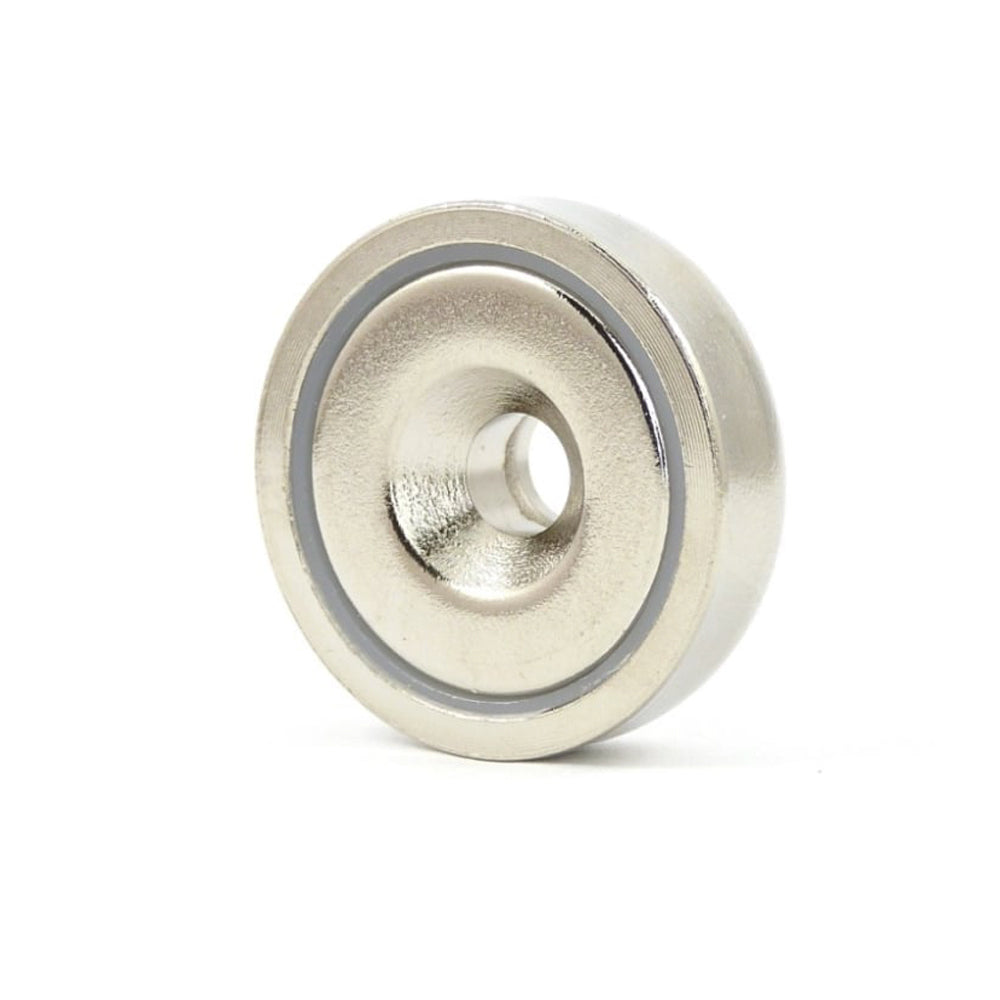
Neodymium Countersunk Pot Magnet - 36mm x 9mm
Neodymium Countersunk Pot Magnet - 36mm x 9mm
Available in stock
Neodymium Countersunk Pot Magnet – 36mm x 9mm
The Neodymium Countersunk Pot Magnet – 36mm x 9mm is a compact rare earth mounting magnet measuring 36mm in diameter x 9mm high. It combines a powerful Neodymium Iron Boron (NdFeB) permanent magnetic element with a steel pot housing and a central countersunk mounting hole, creating a practical magnetic assembly for secure mechanical installation onto suitable components.
The steel pot helps form an efficient magnetic circuit by directing and concentrating useful magnetic flux toward the magnet's active working face. It also provides additional protection around the sides and rear of the brittle neodymium magnetic element. The countersunk hole allows the pot magnet to be mechanically fastened using an appropriately sized compatible countersunk screw, enabling a low-profile installation where the fastener head can sit within the countersunk recess.
With its 36mm diameter and 9mm height, this neodymium pot magnet is suited to engineering, manufacturing, fixtures, jigs, machinery, signage, displays, cabinetry, removable components, workshop equipment, prototypes and custom OEM assemblies.
Also known as a neodymium countersunk pot magnet, rare earth cup magnet, countersunk mounting magnet, NdFeB pot magnet, countersunk magnetic base or neodymium cup magnet, it provides permanent magnetic attraction without electricity, batteries or charging.
Key Features
- Diameter: 36mm
- Height: 9mm
- Shape: Round / circular pot magnet
- Magnetic material: Neodymium Iron Boron (NdFeB)
- Magnet type: Rare earth permanent magnet assembly
- Housing: Steel pot
- Mounting: Central countersunk hole
- Steel pot helps concentrate magnetic flux toward the active face
- Housing helps protect the sides and rear of the magnetic element
- Countersunk design allows mechanical fastening
- Suitable for low-profile mounting applications
- High magnetic performance relative to size
- Suitable for engineering and manufacturing
- Useful for fixtures and jigs
- Suitable for machinery and equipment
- Useful for signage and display mounting
- Suitable for removable and repositionable magnetic assemblies
- Permanent magnetic operation
- No electricity, batteries or charging required
Common Applications
- Engineering
- Manufacturing
- Industrial equipment
- Machinery
- Fixtures and jigs
- Component positioning
- Magnetic mounting
- Removable panels
- Signage
- Displays
- Cabinetry
- Furniture
- Workshop equipment
- Maintenance applications
- Product assemblies
- Equipment housings
- Prototype devices
- Custom OEM assemblies
36mm Diameter x 9mm High Pot Magnet
This countersunk neodymium pot magnet measures 36mm in diameter x 9mm high.
Its compact circular construction combines a relatively broad working face with a low-profile 9mm height, making it suitable for installations where magnetic performance and limited mounting depth are important considerations.
Potential uses include:
- Shallow housings
- Equipment fixtures
- Magnetic mounting points
- Removable components
- Display systems
- Machinery
- Product assemblies
- Custom brackets
The stated dimensions describe the physical geometry of the pot magnet and should not be interpreted as a pull-force or safe working load.
What Is a Neodymium Pot Magnet?
A neodymium pot magnet incorporates an NdFeB rare earth magnetic element within a steel housing or cup.
The steel pot forms part of the magnetic circuit and helps direct useful magnetic flux toward the active working face.
This construction can provide several practical benefits:
- Concentrates useful magnetic attraction at the working face
- Protects the sides and rear of the neodymium element
- Provides a practical format for mechanical installation
- Allows strong magnetic attachment to suitable ferromagnetic surfaces
- Reduces exposed brittle magnetic material compared with an unprotected magnet
Pot magnets are commonly used where magnetic attraction is required primarily from one working face.
Central Countersunk Mounting Hole
This pot magnet features a central countersunk mounting hole.
The countersunk recess is designed to accommodate a suitably sized compatible countersunk-head fastener, allowing the fastener head to sit within the recess rather than projecting substantially from the magnetic face.
This can be useful for:
- Equipment mounting
- Fixtures
- Brackets
- Signage
- Displays
- Furniture
- Cabinetry
- Machinery
- Product assemblies
The exact countersunk hole diameter, countersink dimensions and compatible screw size have not been supplied and should not be assumed.
Confirm the required fastener dimensions before installation.
Installing a Countersunk Pot Magnet
For mechanical installation:
- Confirm the fastener dimensions are compatible with the countersunk hole.
- Position the pot magnet correctly within the assembly.
- Ensure the supporting component provides appropriate mechanical support.
- Insert the compatible countersunk fastener.
- Tighten only sufficiently to secure the assembly.
- Avoid excessive tightening or uneven loading.
The screw should retain the pot magnet without placing unnecessary mechanical stress on the magnetic assembly.
Avoid Overtightening
Neodymium Iron Boron is hard but brittle.
Although the surrounding steel pot provides additional protection, excessive fastener torque can potentially damage the magnetic element or assembly.
Do not overtighten the countersunk screw.
Where appropriate, use installation methods that prevent excessive mechanical stress and verify that the selected fastener seats correctly within the countersunk recess.
Neodymium Iron Boron Rare Earth Magnet
Neodymium Iron Boron is a high-performance rare earth permanent magnetic material widely used where substantial magnetic performance is required from compact dimensions.
NdFeB magnets are commonly selected for:
- Engineering
- Manufacturing
- Machinery
- Fixtures
- Magnetic mounting
- Positioning
- Product integration
The specific neodymium grade has not been supplied for this pot magnet and should not be assumed.
Steel Pot Magnetic Circuit
The surrounding steel housing performs an important magnetic and mechanical function.
It helps form a magnetic circuit that directs and concentrates magnetic flux toward the active working face.
For effective magnetic attraction, the active face should generally be positioned against a:
- Clean
- Flat
- Sufficiently thick
- Ferromagnetic steel surface
Practical holding depends on the entire magnetic circuit rather than the magnet's diameter alone.
Removable Magnetic Mounting
Countersunk pot magnets can be useful for creating removable or repositionable attachments to suitable steel surfaces.
Depending on the application, they can allow components to be attached magnetically without drilling or welding into the target steel surface.
Potential removable components include:
- Signs
- Displays
- Fixtures
- Equipment accessories
- Panels
- Brackets
- Product components
The pot magnet itself can be mechanically fastened to the component using its countersunk hole, while the active face attaches magnetically to compatible steel.
This arrangement can make equipment easier to reposition, remove or service.
Fixtures and Jigs
This 36mm countersunk pot magnet can be incorporated into fixtures and jigs for:
- Component positioning
- Temporary holding
- Assembly assistance
- Inspection fixtures
- Repeatable locating
- Workshop tooling
- Prototype systems
Magnetic holding should not replace appropriate mechanical clamping where movement could create a safety hazard.
Signage and Display Mounting
Countersunk pot magnets can provide a practical attachment method for removable signs and displays.
Potential applications include:
- Retail signage
- Exhibition displays
- Information panels
- Equipment identification
- Temporary signs
- Display fixtures
The countersunk hole provides mechanical attachment to the sign or bracket, while the active magnetic face can attach to compatible ferromagnetic structures.
Magnetic Performance
Practical magnetic performance depends on factors including:
- Neodymium grade
- Pot design
- Magnetic circuit
- Target steel composition
- Target steel thickness
- Contact area
- Surface flatness
- Air gaps
- Paint and coatings
- Load direction
- Mechanical leverage
No specific pull force or magnetic flux density in Gauss has been supplied.
These values should not be inferred from the 36mm diameter x 9mm height alone.
Pull Force vs Safe Working Load
Where a pot magnet has a published pull-force figure, it is normally determined under specific test conditions, often involving direct contact with a suitable thick steel test surface.
Real-world performance can be substantially different.
Pull force should not automatically be treated as:
- Maximum hanging weight
- Safe working load
- Rated lifting capacity
No pull-force value has been supplied for this product.
Direct Pull vs Shear Force
Pot magnets generally perform most effectively when the load attempts to pull the active magnetic face directly away from the steel target.
A vertically mounted magnet may instead experience shear force, where the attached component attempts to slide down the steel surface.
Shear holding depends strongly on:
- Surface friction
- Contact quality
- Load direction
- Surface coatings
- Mechanical leverage
- Vibration
For vertical mounting applications, test the complete assembly under realistic conditions.
Mechanical Leverage
The position of the load relative to the magnetic face can significantly affect practical holding.
A bracket, sign or component projecting away from the magnet can create leverage that attempts to peel the magnetic face away from the target.
The further the load extends from the steel surface, the greater this effect may become.
For projecting components, consider:
- Load weight
- Centre of gravity
- Bracket length
- Installation orientation
- Vibration
- Secondary mechanical retention
Air Gaps and Surface Coatings
Even small gaps between a neodymium pot magnet and target steel can reduce magnetic attraction.
Air gaps may be introduced by:
- Paint
- Powder coating
- Dirt
- Rust
- Protective films
- Plastic layers
- Uneven surfaces
- Mechanical clearance
For maximum practical attraction, unnecessary separation should generally be minimised.
Target Steel Thickness
The target steel must provide a suitable magnetic path for the pot magnet.
Performance can depend on:
- Steel thickness
- Steel composition
- Target dimensions
- Surface condition
- Contact area
- Magnetic saturation
Very thin steel may not provide the same holding performance as a suitably thick ferromagnetic target.
Testing against the actual target material is recommended where holding performance is important.
Compatible Target Materials
This neodymium pot magnet is designed to attract suitable ferromagnetic materials, including:
- Mild steel
- Iron
- Magnetic steel
- Compatible ferromagnetic components
It will not effectively attract inherently non-magnetic materials such as:
- Aluminium
- Copper
- Brass
- Plastic
- Timber
- Glass
Many stainless steel grades can also be weakly magnetic or non-magnetic and should be tested before relying on magnetic attraction.
Countersunk Pot Magnet vs Round-Hole Pot Magnet
Countersunk and straight round-hole pot magnets provide different mounting arrangements.
A countersunk pot magnet has a shaped recess designed for a compatible countersunk-head fastener, allowing the screw head to sit more closely within the pot magnet profile.
A round-hole pot magnet uses a straight mounting hole without the same countersunk recess.
A countersunk design can be useful where:
- A lower-profile fastener installation is required
- The fastener head needs to sit within the recess
- A flush or neater mounting arrangement is preferred
Always confirm the fastener dimensions before installation.
Neodymium vs Ferrite Pot Magnets
Neodymium and ferrite pot magnets provide different characteristics.
Neodymium pot magnets generally provide:
- Higher magnetic performance relative to size
- Strong magnetic properties from compact dimensions
- Advantages where installation space is limited
- Suitability for higher-performance magnetic mounting
Ferrite pot magnets generally provide:
- Lower cost
- Good natural corrosion resistance of the ferrite element
- Good resistance to demagnetisation
- Suitability for many general-purpose magnetic applications
Neodymium is commonly selected where higher magnetic performance from a compact pot magnet assembly is required.
Permanent Magnetic Operation
This neodymium countersunk pot magnet is a permanent magnetic assembly.
It requires:
- No electricity
- No batteries
- No charging
- No external power supply
Its magnetic field remains continuously active during normal use.
Technical Specifications
- Product Type: Neodymium Countersunk Pot Magnet
- Alternative Names: Rare Earth Countersunk Pot Magnet, NdFeB Pot Magnet, Neodymium Cup Magnet, Countersunk Magnetic Base, Countersunk Mounting Magnet
- Diameter: 36mm
- Height: 9mm
- Shape: Round / Circular
- Magnetic Material: Neodymium Iron Boron (NdFeB)
- Housing: Steel Pot
- Mounting Type: Central Countersunk Hole
- Magnet Type: Rare Earth Permanent Magnetic Assembly
- Magnetic Operation: Permanent
- Power Required: None
- Compatible Targets: Suitable ferromagnetic iron and steel
- Primary Functions: Magnetic mounting, holding, positioning and removable attachment
- Typical Applications: Engineering, manufacturing, fixtures, jigs, machinery, signage, displays, cabinetry, equipment and OEM assemblies
Safety and Handling
Neodymium pot magnets can produce substantial magnetic attraction and should be handled carefully.
Keep the magnetic face under control when approaching steel surfaces or other magnets.
Sudden attraction may create:
- Finger pinch hazards
- Trapping injuries
- Magnet collisions
- Damage to nearby components
- Chipping or cracking of the internal magnetic element
Do not overtighten fasteners through the countersunk mounting hole.
Keep powerful permanent magnets an appropriate distance from pacemakers, implanted medical devices, magnetic storage media, magnetic cards and sensitive electronic equipment.
Keep magnets securely away from children.
Please Note
This product is a Neodymium Countersunk Pot Magnet measuring 36mm in diameter x 9mm high, incorporating a Neodymium Iron Boron (NdFeB) rare earth magnetic element within a steel pot housing.
The steel pot helps form the magnetic circuit and direct or concentrate useful magnetic flux toward the active working face.
The central countersunk hole is designed for mechanical installation using an appropriately sized compatible countersunk fastener. The exact hole diameter, countersink dimensions and compatible fastener size have not been supplied and should not be assumed. Avoid overtightening during installation.
No specific neodymium grade, pull force, Gauss rating, coating or plating, dimensional tolerance or maximum operating temperature has been supplied and these specifications should not be assumed.
Actual magnetic performance depends on the neodymium grade, pot design, magnetic circuit, target steel composition and thickness, available contact area, surface condition, air gaps, load direction and mechanical leverage.
The stated 36mm diameter x 9mm height describes the physical geometry of the pot magnet and does not represent its pull force, holding capacity or safe working load.
This magnet is not certified lifting equipment and should not be used for overhead or safety-critical lifting.
Pull Force Information
Pull Force Information
Pull force refers to the maximum holding strength of a magnet. Measured in kilograms, it represents the amount of weight a magnet can support when attached to 10mm thick mild steel, with full, flat, and direct surface-to-surface contact.
A magnet's pull force can be affected by several factors, including its orientation (horizontal vs. vertical) and the presence of any air gaps between the magnet and the surface it’s attached to.
Your payment information is processed securely. We do not store credit card details nor have access to your credit card information.