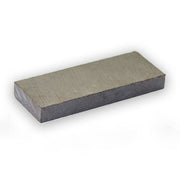
Ferrite Block Magnet - 50mm x 19mm x 6.1mm
Ferrite Block Magnet - 50mm x 19mm x 6.1mm
Available in stock
Ferrite Block Magnet – 50mm x 19mm x 6.1mm
The Ferrite Block Magnet – 50mm x 19mm x 6.1mm is a rectangular ceramic permanent magnet measuring 50mm long x 19mm wide x 6.1mm thick. Manufactured from ferrite magnetic material, this slim block magnet provides an economical magnetic solution for industrial equipment, manufacturing, product assemblies, displays, magnetic holding, positioning, educational projects, prototypes and custom OEM applications.
Also known as a ceramic block magnet, rectangular ferrite magnet, ferrite bar magnet or ceramic rectangular magnet, its elongated 50mm x 19mm footprint and relatively slim 6.1mm thickness make it suitable for applications requiring a flat rectangular magnetic component. Ferrite magnets provide good natural corrosion resistance and resistance to demagnetisation, making them widely used for general-purpose magnetic applications.
As a permanent magnet, this ferrite block requires no electricity, batteries or charging to maintain its magnetic field.
Key Features
- 50mm length x 19mm width x 6.1mm thickness
- Rectangular block / bar shape
- Slim 6.1mm profile
- Ferrite / ceramic permanent magnetic material
- Economical magnetic solution
- Good natural corrosion resistance
- Good resistance to demagnetisation
- Suitable for magnetic holding and positioning
- Useful for product and equipment assemblies
- Suitable for displays and signage
- Useful for educational and experimental applications
- Permanent magnetic operation
- No electricity or batteries required
- Suitable for prototypes and OEM products
Common Applications
- Industrial equipment
- Manufacturing
- Engineering projects
- Product assemblies
- Magnetic holding
- Magnetic positioning
- Displays and signage
- Fixtures and jigs
- Furniture and cabinetry
- Educational projects
- School science demonstrations
- Models and prototypes
- Research and development
- Custom magnetic assemblies
- OEM manufacturing
50mm x 19mm x 6.1mm Ferrite Block Magnet
This rectangular ferrite magnet measures:
- Length: 50mm
- Width: 19mm
- Thickness: 6.1mm
Its elongated rectangular profile provides a relatively broad magnetic footprint while maintaining a slim overall thickness.
This geometry can be useful for integration into:
- Rectangular recesses
- Product housings
- Display assemblies
- Fixtures
- Machinery
- Equipment
- Furniture
- Custom manufactured components
The supplied dimensions describe the magnet's physical size and should not be interpreted as a magnetic pull-force or load-capacity rating.
Ferrite Ceramic Permanent Magnet
Ferrite magnets, also commonly called ceramic magnets, are widely used permanent magnetic materials manufactured from iron oxide combined with ceramic magnetic compounds.
They offer a useful combination of:
- Economical cost
- Permanent magnetic performance
- Good natural corrosion resistance
- Good resistance to demagnetisation
- Suitability for many general-purpose applications
Ferrite magnets typically have a dark grey to black ceramic appearance and generally do not require metallic protective plating for ordinary corrosion protection.
The specific ferrite magnetic grade of this block magnet has not been supplied and should not be assumed.
Slim Rectangular Magnetic Profile
At just 6.1mm thick, this ferrite block has a relatively low-profile form compared with its 50mm length and 19mm width.
This can make it useful for applications where installation depth is limited, including:
- Shallow recesses
- Display systems
- Product assemblies
- Furniture components
- Equipment housings
- Removable components
- Prototype systems
When integrating the magnet into an assembly, adequate mechanical support should be provided because ferrite is a hard and brittle ceramic material.
Magnetic Holding and Positioning
This rectangular ferrite magnet may be incorporated into magnetic holding and positioning systems.
Potential applications include:
- Holding components against steel
- Positioning parts
- Locating components
- Removable attachments
- Fixtures and jigs
- Product assemblies
- Display systems
- Custom magnetic mechanisms
Actual holding performance depends on the complete magnetic circuit and mechanical installation.
Displays and Signage
The flat rectangular geometry can also be useful for magnetic display and signage systems.
Potential uses include:
- Removable signs
- Display panels
- Retail fixtures
- Exhibition displays
- Point-of-sale components
- Product presentation systems
- Magnetic labels and holders
For bonded applications, the adhesive and substrate should be selected according to the weight, surface material and operating environment.
Fixtures, Jigs and Manufacturing
Ferrite block magnets can be incorporated into manufacturing equipment and non-safety-critical fixtures where economical permanent magnetic attraction is required.
Potential uses include:
- Assembly fixtures
- Positioning aids
- Removable guides
- Product manufacturing
- Equipment attachments
- Inspection fixtures
- Prototype systems
Magnetic holding should not be relied upon as the sole retention method where unexpected release could create a hazard.
Magnetisation Direction
The magnetisation direction of this 50mm x 19mm x 6.1mm ferrite block magnet has not been supplied.
Rectangular magnets may be produced with different magnetic orientations, so the position of the north and south poles should not be inferred solely from the magnet's shape.
Magnetisation direction can affect:
- Pole location
- Selection of working surfaces
- Magnet-to-magnet attraction
- Holding performance
- Sensor response
- Magnetic circuit design
Where pole orientation is important, magnetisation direction should be confirmed before installation.
Magnetic Holding Performance
Actual magnetic performance depends on factors including:
- Ferrite magnetic grade
- Magnetisation direction
- Target steel thickness
- Target steel composition
- Available contact area
- Surface flatness
- Air gaps
- Paint and coatings
- Magnet orientation
- Load direction
- Magnetic circuit design
No specific pull force or magnetic flux density in Gauss has been supplied for this product and these values should not be inferred solely from its dimensions.
Direct Pull vs Shear Force
Magnetic holding performance changes according to the direction of the applied load.
Direct pull occurs when force attempts to separate the magnet perpendicular to the target steel surface.
Shear loading occurs when force acts parallel to the target surface and encourages the magnet to slide.
Practical vertical holding performance may therefore be considerably lower than ideal direct-pull performance.
Vibration, shock and leverage can reduce practical holding further.
Air Gaps and Surface Condition
Ferrite magnets generally provide better magnetic attraction when positioned close to suitable ferromagnetic steel.
Performance can be reduced by non-magnetic gaps created by:
- Paint
- Powder coating
- Adhesive
- Plastic
- Dirt
- Rust
- Protective coatings
- Uneven surfaces
Minimising unnecessary separation between the magnet and target steel can improve practical magnetic performance.
Bonding a Ferrite Block Magnet
The flat rectangular surfaces can make this magnet suitable for adhesive installation into compatible housings and recesses.
For bonding:
- Clean the magnet and substrate thoroughly
- Remove oil, grease, dust and contamination
- Select an adhesive suitable for both materials
- Follow the adhesive manufacturer's preparation instructions
- Avoid unnecessarily thick adhesive layers
- Allow the adhesive to cure fully before loading
- Avoid force-fitting the magnet into an undersized recess
Because ferrite is brittle, mechanical pressure should be kept within appropriate limits.
Compatible Target Materials
Ferrite magnets attract ferromagnetic iron and compatible steels.
Suitable target materials may include:
- Mild steel
- Iron
- Magnetic steel
- Ferromagnetic fasteners
- Compatible steel structures
- Steel machinery components
Ferrite magnets will not effectively attract:
- Aluminium
- Copper
- Brass
- Plastic
- Timber
- Glass
Many stainless steel grades may also provide weak or negligible magnetic attraction and should be tested before use.
Ferrite vs Neodymium Block Magnets
Ferrite and neodymium are both permanent magnetic materials, but they offer different characteristics.
Ferrite magnets generally provide:
- Economical magnetic performance
- Good natural corrosion resistance
- Good resistance to demagnetisation
- Suitability for many general-purpose applications
- No requirement for protective metallic plating in many environments
Neodymium magnets generally provide:
- Significantly higher magnetic strength relative to size
- Greater magnetic performance from compact dimensions
- Suitability where space is limited and higher magnetic strength is required
Ferrite is often selected where cost effectiveness, corrosion resistance and reliable general-purpose magnetic performance are more important than maximum magnetic strength relative to size.
Educational and Science Applications
Rectangular ferrite magnets can also be useful for supervised educational demonstrations involving fundamental magnetic principles.
Potential demonstrations include:
- Magnetic attraction
- Magnetic repulsion
- North and south poles
- Magnetic fields
- Ferromagnetic materials
- Magnet-to-magnet interaction
- Simple magnetic mechanisms
Because the magnetisation direction has not been supplied, pole locations should be confirmed where an experiment depends on a particular magnetic orientation.
Permanent Magnetic Operation
This 50mm x 19mm x 6.1mm ferrite block is a permanent magnet.
It requires:
- No electricity
- No batteries
- No charging
- No electrical wiring
Its magnetic field remains continuously active during normal use.
Technical Specifications
- Product Type: Ferrite Block Magnet
- Alternative Names: Ceramic Block Magnet, Rectangular Ferrite Magnet, Ferrite Bar Magnet, Ceramic Rectangular Magnet
- Length: 50mm
- Width: 19mm
- Thickness: 6.1mm
- Shape: Rectangular Block / Bar
- Magnetic Material: Ferrite / Ceramic
- Magnet Type: Permanent Magnet
- Magnetic Operation: Permanent
- Power Required: None
- Target Materials: Compatible ferromagnetic iron and steel
- Primary Functions: Magnetic attraction, holding, positioning and integration into magnetic assemblies
- Typical Applications: Manufacturing, engineering, displays, fixtures, product assemblies, education, prototypes and OEM products
Handling Ferrite Block Magnets
Ferrite is a hard and brittle ceramic magnetic material.
This is particularly important with a relatively slim rectangular magnet, as excessive bending or mechanical leverage may cause cracking or breakage.
Avoid:
- Dropping the magnet onto hard surfaces
- Allowing magnets to collide forcefully
- Applying bending forces
- Using the magnet as a structural component
- Force-fitting into an undersized recess
- Drilling
- Cutting
- Conventional machining
Broken ferrite fragments can have sharp edges and should be handled carefully.
Please Note
This product is a Ferrite Block Magnet measuring 50mm long x 19mm wide x 6.1mm thick, manufactured from ferrite / ceramic permanent magnetic material.
No specific ferrite grade, pull force, Gauss rating, magnetisation direction, dimensional tolerance, coating or maximum operating temperature has been supplied and these specifications should not be assumed.
Actual magnetic performance depends on magnetic grade, magnetisation direction, target steel thickness and composition, available contact area, air gaps, surface condition, magnet orientation and load direction.
Ferrite offers good natural corrosion resistance and resistance to demagnetisation but is a hard and brittle ceramic material. Avoid impact, bending, drilling, cutting, machining and force-fitting.
Where magnetic holding is used in an application in which unexpected release could cause injury or damage, incorporate appropriate mechanical retention and safety measures.
Pull Force Information
Pull Force Information
Pull force refers to the maximum holding strength of a magnet. Measured in kilograms, it represents the amount of weight a magnet can support when attached to 10mm thick mild steel, with full, flat, and direct surface-to-surface contact.
A magnet's pull force can be affected by several factors, including its orientation (horizontal vs. vertical) and the presence of any air gaps between the magnet and the surface it’s attached to.
Your payment information is processed securely. We do not store credit card details nor have access to your credit card information.